The Panama Papers Could Lead to Capitalism’s Great Crisis | TIME

9 Apr

To me, this is one of the key issues at work in the U.S. presidential election. Voters know at a gut level that our system of global capitalism is working mainly for the 1 %, not the 99 %. That’s a large part of why both Sanders and Trump have done well, because they tap into that truth, albeit in different ways. The Panama Papers illuminate a key aspect of why the system isn’t working–because globalization has allowed the capital and assets of the 1 % (be they individuals or corporations) to travel freely, while those of the 99 % cannot. Globalization is supposed to be about the free movement of people, goods, and capital. But in fact, the system is set up to enable that mobility mainly for the rich (or for large corporations). The result is global tax evasion, the offshoring of labor, and an elite that flies 35,000 feet over the problems of nation states and the tax payers within them.

Where do we go from here? I think we’re heading towards a root to branch re-evaluation of how our market system works–and doesn’t work. The debate over free trade is part of that re-evaluation. The calls for a global campaign against tax evasion are, too. I think there will also be intense scrutiny about the ease with which financial capital can move around the world – we’ve already seen that with the hoopla over tax inversions, but we’ll see a lot more backlash, in new areas.

Source: The Panama Papers Could Lead to Capitalism’s Great Crisis | TIME

Keeping sea lanes open: a benefit cost analysis — Crooked Timber

8 Apr

Would a crisis in the South China Sea, presumably caused by a Chinese attempt to claim control, have such a huge adverse effect? It is routinely pointed out that the volume of trade passing through the South China Sea ($5.3 trillion on this estimate ) is very large. But the great majority of this trade (around $4 trillion) is going to or from China.[^1] Obviously, the Chinese government can control this trade in any way it chooses through domestic policies and has no interest in blocking it. The remaining $1 trillion or so of trade (about 1.5 per cent of global GDP) might, in the event of a crisis, be forced to take more circuitous routes, as happened when the Suez canal was blocked. But using the same method as was applied to Suez, it’s easy to see that the total impact would be modest.

On past experience, it seems highly unlikely that an economic analysis of this kind will have any effect on military policy discussions. Vague claims about economic interests loom large in such discussions, and attempts to pin them down to concrete realities are routinely evaded. The century beginning with World War I, and running through to the trillion-dollar quagmires in Iraq and Afghanistan has seen countless demonstrations that, under modern conditions, war is almost invariably an economic disaster for all concerned. That hasn’t stopped war, and preparation for war, being considered as an essential part of a national economic strategy, and it seems unlikely to do so.

Source: Keeping sea lanes open: a benefit cost analysis — Crooked Timber

End of the End of History, Redux | n+1 | aka the Bernie Sanders Moment|

5 Apr

There the similarities end. While Bill Bradley dropped out of the primary race in 2000 after losing the first twenty primaries to Al Gore, Bernie Sanders, so far, has won eleven out of twenty-nine states over Hillary Clinton in 2016. No intra-party realignment has taken place since 2000. Sanders’s core constituencies are identical to Bradley’s: the working class, upper-middle-class mugwumps, and youth. But the disasters of the Bush administration and the inadequacies of Obama’s efforts at reform and recovery have hardened the resolve of these constituencies politically and the fragility of the economy, coupled with the persistence of income inequality, has increased their demographic weight.

Sanders’ rhetoric of “political revolution” signals to them that he is a candidate who clearly understands that democracy conducted along neoliberal lines was fatally injured in the 2008 crash. Talk of socialism is no longer taboo; systemic change, in one form or another, is imminent. The Vermont senator is reactivating sectors of the Democratic base captivated by Obama’s campaign only to be demobilized and disappointed by Obama’s record in office: within and without the party, Sanders can win over voters that Clinton, with her irrevocably tainted record of collusion with corporate interests and support from neoliberal intellectuals, never could. The narrative being presented, all but unanimously, by the professional political press is exactly wrong. It is Sanders, not Clinton, who has a higher electoral ceiling. Even if one sets the Sanders-dominated youth vote aside, the older left-tending working-class voters depressed by NAFTA and subsequent Clinton-backed trade agreements—all of which Sanders vehemently opposed—significantly outnumber the only Democratic bloc bitterly opposed to a Sanders nomination: the contented upper-middle class of which the professional political press is part, and whose interests it amplifies, albeit with diminishing effect. The assertion from the commentariat that Sanders is unviable in the general election can be reduced to the proposition that said commentariat, and the ever-shrinking proportion of voters who take its word as authoritative, would hate to vote for him—no less, but also no more.

Like Perot, who he resembles temperamentally, Sanders is wagering that he can win a rigged game; unlike the Texan businessman, however, the Senator has some experience in the matter of winning elections. His relative restraint with regards to his primary opponent should not necessarily be taken as a sign of weakness or naivete, nor should it be taken as a permanent fact: if he continues to perform above expectations, the condescension aimed at him from above will reach such a pitch as to justify counter-attacking, and he will need fresh charges to level then.

Source: End of the End of History, Redux | Online Only | n+1

Children Now Spend Less Time Outside than the Average Prisoner

1 Apr

A global survey conducted on children’s time outdoors quickly became an ongoing campaign called “Dirt is Good” after the findings showed a concerning lack of outdoor playtime among children aged five to twelve. The results of the survey, commissioned by British laundry company Persil and conducted by an independent market research firm, revealed ⅓ of British children spend 30 minutes or less outside every day — and that one in five does not play outside at all on an average day. The researchers surveyed 12,000 parents spanning 10 countries: the United States, Brazil, U.K., Turkey, Portugal, South Africa, Vietnam, China, Indonesia, and India.

The Dirt is Good initiative was founded based on the survey, and the short film of the same name, which features interviews with inmates, reports that “on average, children now spend less time outdoors than a prison inmate.” According to Dirt is Good, inmates receive at least two hours of time outside every day while most children enjoy an hour or less.

The inmates interviewed in the short film expressed the importance of their outdoor time.

“I think it’s probably the most important part of my day,” one inmate says. It “keeps my mind right, keeps my body strong,” another explains. Yet another calls his time outside “pretty much the highlight of my day.”

Source: Children Now Spend Less Time Outside than the Average Prisoner

The revolt of the public and the rise of Donald Trump | the fifth wave

31 Mar

A meticulous study of Donald Trump’s biography, statements, and policy “positions” will reveal no hint of political direction.  It’s not that Trump is contradictory or incoherent.  He’s ideologically formless.  His claim to business competence is nullified by inherited wealth and several bankruptcies.  His supposed nationalism consists of complaining about countries in which he has invested his own money (“I love China, but…”).  He’s going to make America great again – yet that’s a wish, not a program.  A run at the US presidency has been concocted out of a disorganized bundle of will and desire.

A candidate deprived of direction can only drift on the stream of public opinion.  Or to flip that around:  the dizzying rise of Trump can best be understood as the political assertion of a newly energized public.  Trump has been chosen by this public, for reasons I’ll have cause to examine, and he is the visible effect, not the cause, of this public’s surly and mutinous mood.  To make him into an American Hitler or a world-historical figure of any sort, let me suggest, would be to distort reality as on a funhouse mirror.

The right level of analysis on Trump isn’t Trump, but the public that endows him with a radical direction and temper, and the decadent institutions that have been too weak to stand in his way.

The American public, like the public everywhere, is engaged in a long migration away from the structures of representative democracy to more sectarian arrangements.  In Henri Rosanvallon’s term, the democratic nation has devolved into a “society of distrust.”  The reasons, Rosanvallon argues, are deep and structural, but we also have available a simple functional explanation:  the perception, not always unjustified, that democratic government has failed to deliver on its promises.

Source: The revolt of the public and the rise of Donald Trump | the fifth wave

Is universal mistrust the moral foundation of this stage of capitalist society?

31 Mar
Over at Crooked Timber Corey Robin has a post, The Bernie Sanders Moment: Brought to you by the generation that has no future. Here’s the first paragraph:
Last week I met with a group of ten interns at a magazine. The magazine runs periodic seminars where interns get to meet with a journalist, writer, intellectual, academic of their choosing. We talked about politics, writing, and so on. But in the course of our conversation, one startling social fact became plain. Although all of these young men and women had some combination of writerly dreams, none of them—not one—had any plan for, even an ambition of, a career. Not just in the economic sense but in the existential sense of a lifelong vocation or pursuit that might find some practical expression or social validation in the form of paid work. Not because they didn’t want a career but because there was no career to be wanted. And not just in journalism but in a great many industries.
The discussion has been going on a bit, as many discussions do at Crooked Timber. I was particularly struck by this observation by George Scialabba (comment 156):
It would be interesting to know, if one could quantify such things, what proportion of all the communications one receives (or better, perhaps, the stimuli one experiences) in an average day are some form of advertising or marketing. I’d guess a large majority. In which case, a hypothesis presents itself: the nature and function of human communication has altered. Through most of history, the default reaction to any communication was “this is what the speaker believes.” One needed only to judge the credibility of the speaker in order to know how to act. In the 21st century, after generations of saturation advertising, much or most of it deceptive or at least manipulative, the default reaction is “this is what the speaker, for some purpose of his/her own, wants me to believe.” Virtually all public communication may safely be presumed to be aiming at some effect, rather than simply at conveying information or conviction. Finding out what the speaker actually believes, much less what’s actually true or false, is the hearer’s responsibility: caveat auditor. Universal mistrust is the moral foundation of this stage, at least, of capitalist society. Hence, honesty is no longer the best policy.

E. O. Wilson on preserving biodiversity

5 Mar

This week he publishes his 32nd book, Half Earth: Our Planet’s Fight for Life, in which he argues that we must set aside half the earth a preserve for non-human life. Claudia Dreifus interviews him in The New York Times:

Q. Why publish this book now?

A. Because a lifetime of research has magnified my perception that we are in a crisis with reference to the living part of the environment.We now have enough measurements of extinction rates and the likely rate in the future to know that it is approaching a thousand times the baseline of what existed before humanity came along.

Reading your book, one senses you felt a great urgency to write it?

The urgency was twofold. First, it’s only been within the last decade that a full picture of the crisis in biodiversity has emerged. The second factor was my age. I’m 86. I had a mild stroke a couple of years ago. I thought, “Say this now or never.”

And what I say is that to save biodiversity, we need to set aside about half the earth’s surface as a natural reserve. I’m not suggesting we have one hemisphere for humans and the other for the rest of life. I’m talking about allocating up to one half of the surface of the land and the sea as a preserve for remaining flora and fauna.

In a rapidly developing world, where would such a reserve be?

Large parts of nature are still intact — the Amazon region, the Congo Basin, New Guinea. There are also patches of the industrialized world where nature could be restored and strung together to create corridors for wildlife. In the oceans, we need to stop fishing in the open sea and let life there recover. The open sea is fished down to 2 percent of what it once was. If we halted those fisheries, marine life would increase rapidly. The oceans are part of that 50 percent.

So, what about Trump, eh?

2 Mar
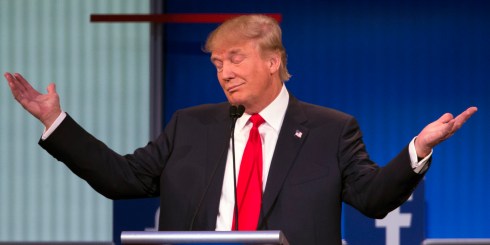
I’m afraid I don’t have anything particularly insightful to say about the astonishing rise of Donald Trump. Like just about everyone else – including, who knows, even Trump himself – I didn’t take him seriously. I figured he wasn’t in it to win, just to get publicity. Now it looks like he’s stuck making a serious run for it. He’s the favorite for the GOP nomination and, after that, who knows?
On the other hand, I can’t say that, however his political viability scares me, I’m deeply surprised that something like this is happening. Some years ago, as some of you may know, David Hays and I developed a descriptive account of cultural evolution [1], which allows for radical discontinuities in historical development. It was clear to us in our original discussions back in the late 1970s and after, and it is clear to me now, that we are living in an era of discontinuity.
The ascendency of Donald Trump can certainly be read as a symptom of a deep discontinuity. But if that is so, then how can we predict the future? If the discontinuity is THAT deep, then the past and immediate present give us little or know basis on which to make predictions. We’re at sea on a strange planet.
* * * * *
In an editorial from yesterday (March 1, 2016), The New York Times suggests that the Republicans brought this on themselves:
“If a person wants to be the nominee of the Republican Party, there can be no evasion and no games,” House Speaker Paul Ryan said on Tuesday, after months of such games. He sounded naïvely unaware of the darker elements within the Republican Party, present for decades, and now holding sway: “This party does not prey on people’s prejudices. We appeal to their highest ideals. This is the party of Lincoln.”
The Republican Party is taking a big step toward becoming the party of Trump. Those who could challenge Mr. Trump — Ted Cruz and Marco Rubio — are not only to the right of Mr. Trump on many issues, but are embracing the same game of exclusion, bigotry and character assassination. That Mr. Rubio would make double entendres about the size of Mr. Trump’s hands and talk about Mr. Trump wetting his pants shows how much his influence has permeated this race and how willingly his rivals are copying his tactics.
Does this mean that the Republicans are now helpless to stop Trump from getting the nomination?

Continue reading

Peak Paper

22 Feb
IMGP1414rd
Over at Crooked Timber John Quiggin has a post on peak paper:
In 2013, the world reached Peak Paper. World production and consumption of paper reached its maximum, flattened out, and is now falling. In fact, the peak in the traditional use of paper, for writing and printing, took place a few years earlier, but was offset for a while by continued growth in other uses, such as packaging and tissues.
China, by virtue of its size, rapid growth and middle-income status is the bellwether here; as China goes, so goes the world. Unsurprisingly in this light, China’s own peak year for paper use also occurred in 2013. Poorer countries, where universal literacy is only just arriving, are still increasing their use of paper, but even in these countries the peak is not far away.

Why does this matter? Because it means that we’re moving beyond the industrial mode of production and so must move beyond the ideas that go along with it, including the idea of perpetual growth:

Peak Paper points up the meaningless of measures of economic growth in an information economy. Consider first the ‘fixed proportions’ assumption that resource inputs, economic outputs and the value of those outputs grow, broadly speaking in parallel. Until the end of the 20th century, these assumptions worked reasonably well for paper, books and newspapers, and the information they transmitted. The volume of information grew somewhat more rapidly than the economy as a whole, but not so rapidly as to undermine the notion of an aggregate rate of economic growth. … In the 21st century, these relationships have broken down. On the one hand, as we have already seen, the production of consumption and paper has slowed and declined. On the other hand, there has been an explosion in the production and distribution of information of all kinds.

On Diverse Uses of Public Lands: An Open Letter to Bernie Sanders and Ron Paul

9 Jan

The armed standoff in Oregon concerning the Malheur Wildlife refuge is only the latest is a long series of conflicts over “public” lands, as R. McGreggor Cawley has pointed out in a recent op-ed in The New York Times. In a quick overview of that history he points out:

In other words, the federal government has attempted to do what Payne, Ammon Bundy and their compatriots ask — “return the land to the people.” Had the Western states accepted the offer, we might have avoided a long train of controversies leading to the Oregon occupation. But when the Western states declined, the second caveat in the Hoover committee recommendations was put into play, and Congress passed the Taylor Grazing Act, establishing a permit-and-fee system for regulating grazing on the public lands. All of that was to be administered by the Department of Interior’s federal Grazing Service — an entity that would eventually become part of the Bureau of Land Management.

But things, as we see, didn’t work out. Conflicts remain. He concludes:

This is what’s important about public-land conflicts: They raise thorny questions about abstract political concepts like democracy. Creating wilderness areas, or instituting environmental regulations, inevitably restricts someone’s access to the land or the purposes they would prefer to see it put to. For those who are restricted, the government’s action may not appear very democratic. It’s in these disputes that we get outside the abstractions of political science and reckon with big questions in a very immediate way: How do we all decide what this land is for, how best to use it, who can be trusted to administer it and how our competing visions for it can be heard — right down to each acre of grass, each deer and each gallon of creek water?

It is in this context that Charlie Keil has drafted an open letter to Bernie Sanders and Ron Paul in which he urges that recognize a diversity of use categories for public lands – the Federal Government administers an eighth of the nation’s landmass – and that we listen seriously to “the armed cowboys in Oregon”.

* * * * *

Open Letter to Bernie Sanders and Ron Paul,

Could you both endorse a statement along the following lines?

We need to recognize a variety of different kinds of public lands: Wilderness, boondocks, the commons, public property, all increase the value, the sacredness, the importance, the preciousness of private property.

We need to create 1) true wilderness areas, 2) wilderness corridors, 3) boondocks surrounding the wilderness areas and corridors working as buffer zones where only a very few people are specially permitted to go there (mostly for religious or spiritual reasons), 4) commons for grazing and other seasonal usages, and 5) public properties with rules for local community sharing. The more we do this, the better off all the diversity of species and diversity of socio-cultural systems will be. The healthier the wilderness, boondocks, commons and public lands are, the happier the human individuals and societies will be.

Finally, the values and treatment of private properties will be enhanced in direct proportion to the amount of land we can safeguard, keep beautiful and healthy all around our human settlements. What might be called a win, win, win, win, situation for all of Creation! And for all of humanity too. The very opposite of a “race to the bottom” or a “tragedy of the commons” in which everyone (people, plants, animals) become losers as a few people with big machinery plunder MotherNature some more.

I don’t believe the armed cowboys in Oregon are Jefferson’s yeoman farmers wanting to homestead. They seem more like the thugs that genocided the Native Americans to steal their lands. They are there in sympathy with convicted arsonists? Burning trees to create grasslands for cattle and more hamburgers? They want to renew the war between grazers and farmers? Do they stand for a land redistribution of some kind that I don’t understand? Let’s hear them out, amplify their message, have some discussions, explain the urgent needs for more wilderness, and then restore the land to wildlife refuge, this time with a boondocks perimeter, plus a commons where Wes Jackson’s perennial grains can be tried out.

Wish I could sign off as a vegetarian but I still crave some free-range chicken once in a while,

Charlie Keil