Archive | Positive Visioning RSS feed for this section

United Nations Tunes Up for First International Jazz Day – NYTimes.com

29 Apr

From its earliest days, when the pianist Jelly Roll Morton spoke of a “Spanish tinge,” jazz has been extraordinarily open to international influences. Now it’s official. Last fall Unesco — the United Nations Educational, Scientific and Cultural Organization — designated jazz a “universal music of freedom and creativity” and decreed that henceforth every April 30 is to be celebrated around the world as International Jazz Day.

via United Nations Tunes Up for First International Jazz Day – NYTimes.com.

Global Warming and the Beginning of the Great Transition

20 Apr

I’ve been thinking about the recent poll showing that a majority of Americans now believe that global warming is real and that it is the cause behind recent extreme weather (as reported in The New York Times):

The poll suggests that a solid majority of the public feels that global warming is real, a result consistent with other polls that have asked the question in various ways. When invited to agree or disagree with the statement, “global warming is affecting the weather in the United States,” 69 percent of respondents in the new poll said they agreed, while 30 percent disagreed.

Not only that, but “one of the more striking findings was that 35 percent of the public reported being affected by extreme weather in the past year.” That is global warming is no longer something affecting only “those people” who live “over there, in that other place far far away from me.” It’s happening here and now, to me!

What’s the ripple effect of these beliefs? William McKibben says ““My sense from around the country and the world is that people definitely understand that things are getting freaky” and his group, 350.org, is planning rallies on May 5 to help people to “Connect the Dots” between the crazy weather we have now and long-term climate change.

Of course those aren’t the only dots that need to be connected. Climate change needs to be connected to energy policy and practices, to farming and ranching and food practices, to relationships between local and global communities, to, well, when you think about it, to just about everything.

Certainly to war and peace. All the time, energy, and resources we throw into way is just thrown away. We need to devote that to saving the earth and thus to saving ourselves and our grandchildren, and their grandchildren.

But first we need to believe that all that must be done. Is this newly emerging consensus on global warming the beginning of that belief? Is this the beginning of the Great Transition?

Vertical Gardens in Mexico a Symbol of Progress – NYTimes.com

10 Apr

“The main priority for vertical gardens is to transform the city,” said Fernando Ortiz Monasterio, 30, the architect who designed the sculptures. “It’s a way to intervene in the environment.”

Many cities have green reputations — Portland, Ore., even has its own vertical gardens. But in the developing world, where middle classes are growing along with consumption, waste and energy use, Mexico City is a brave new world. The laughingstock has become the leader as the air has gone from legendarily bad to much improved. Ozone levels and other pollution measures now place it on roughly the same level as the (also cleaner) air above Los Angeles.

“Both L.A. and Mexico City have improved but in Mexico City, the change has been a lot more,” said Luisa Molina, a research scientist with the Massachusetts Institute of Technology, who has done extensive pollution comparisons. Mexico “is very advanced not just in terms of Latin America, but around the world. When I go to China, they all want to hear the story of Mexico.”

via Vertical Gardens in Mexico a Symbol of Progress – NYTimes.com.

Worker Ownership For the 21st Century? | The Nation

28 Mar

It may not be the revolution’s dawn, but it’s certainly a glint in the darkness. On Monday, this country’s largest industrial labor union [United Steel Workers] teamed up with the world’s largest worker-cooperative to present a plan that would put people to work in labor-driven enterprises that build worker power and communities, too.

Titled “Sustainable Jobs, Sustainable Communities: The Union Co-op Model,” the organizational proposal released at a press conference on March 26 in Pittsburgh, draws on the fifty-five year experience of the Basque-based Mondragon worker cooperatives. To quote the document:

“In contrast to a Machiavellian economic system in which the ends justify any means, the union co-op model embraces the idea that both the ends and means are equally important, meaning that treating workers well and with dignity and sustaining communities are just as important as business growth and profitability.”

There’s ‘boots on the ground’ history behind the project:

It’s been a few years since the USW first became curious about the Mondragon cooperatives after they had a good experience working with GAMESA, a co-op friendly Spanish wind turbine outfit that opened up three plants in Pennsylvania. In 2009, with their Spanish colleagues’ help, Gerard sent a delegation to the Basque region of Spain to investigate Mondragon, now a $24 billion global operation. Since then, the USW has worked slowly with Mondragon and the Ohio Employee Ownership Center (OEOC) a university based coop-outreach center founded by one of the organizers of the Youngstown initiative, to fine tune the US version presented Monday.

For the details of the proposal, check out the model for yourself. The full text of the union co-op model is available at www.usw.coop or www.union.coop.

via Worker Ownership For the 21st Century? | The Nation.

Peace Symbol: Nuclear Disarmament

21 Feb

one of them old time good ones

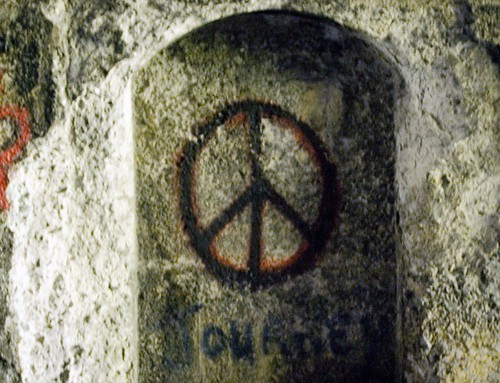
The peace symbol is one of the most widely known symbols in the world. It was created in 1958 by Gerald Holtom as a symbol for the Campaign for Nuclear Disarmament (CND). The symbol combines the semaphor (signal flag) symbols for “N” and “D” (nuclear disarmament). In the “N” the flags are held pointing diagonally toward the ground and, for the “D” one points up and one down, forming a vertical line.

The symbol was used in first anti-nuclear march in London (to Aldermaston, where nuclear weapons were manufactured) in 1958. One of Martin Luther King’s associates, Bayard Rustin, attended that march and brought the symbol back to the US. It was adopted by anti-war movement and has since become a universal symbol of peace.

Note that the symbol has not been copyrighted. The CND explains:

Although specifically designed for the anti-nuclear movement it has quite deliberately never been copyrighted. No one has to pay or to seek permission before they use it. A symbol of freedom, it is free for all. This of course sometimes leads to its use, or misuse, in circumstances that CND and the peace movement find distasteful. It is also often exploited for commercial, advertising or generally fashion purposes. We can’t stop this happening and have no intention of copyrighting it. All we can do is to ask commercial users if they would like to make a donation. Any money received is used for CND’s peace education and information work.

The Evolved Self-management System | Conversation | Edge

7 Dec

And then what about the messages we pick up from the natural world? I’ve become particularly interested in how nature itself may provide placebo information, by seeming to suggest that we’re in the presence of a great designer, a creator, God. Wherever we look, there’s no question the natural world shouts “intelligent design”, shouts of a great artist in the sky. And, admit it or not, I’m sure this can provide a powerful subconscious prime. It can make us believe that we’re in the presence of a loving father, or perhaps a loving partner, someone whom we should look up to and want to get closer to—but who gives us permission to be such selves as we wouldn’t be otherwise. If overt religious messages can act as placebos, then so too can the beauties of nature, so too can the sun and the moon and the stars.

via The Evolved Self-management System | Conversation | Edge.

Black Preaching, the Church, and Civic Life

14 Nov

I can’t say that I’ve even thought of that topic until a two or three weeks ago. Now it’s been much on my mind. What got me thinking about black preaching in the first place, of course, is my recent church visit. But how I got from that visit to this more general issue, black preaching and civic life, that takes a bit of explaining. Where I’m going is that, if we’re going to make substantial changes in how this country, these United States of America, goes about its business, if we’re going to forge a more just and more sustainable union, we’ve got to be grounded in something, something that doesn’t quite exist. Perhaps black preaching has a role to play in that something.

Civics 101: Legitimizing the State

Let’s start with the second paragraph of the Declaration of Independence:

We hold these Truths to be self-evident, that all men are created equal, that they are endowed by their Creator with certain unalienable Rights, that among these are Life, Liberty, and the Pursuit of Happiness—That to secure these Rights, Governments are instituted among Men, deriving their just Powers from the Consent of the Governed, that whenever any Form of Government becomes destructive of these Ends, it is the Right of the People to alter or to abolish it, and to institute new Government, laying its Foundation on such Principles, and organizing its Powers in such Forms, as to them shall seem most likely to effect their Safety and Happiness.

As I’ve observed in another post:

In Jefferson’s formulation the government gains its power by grant from the people. The people, in turn, gain their power, their unalienable rights, from their Creator. This reverses the logic of legitimization prevailing in traditional European monarchies. In those governments the rulers got their legitimacy from God and their subjects, in turn, got their rights and obligations through their relationship to the ruler. In that scheme democracy is implausible. Jefferson, and the new nation, emphatically rejected that scheme in favor of a different one.

In this new system the separation of church and state secures two ends, religious freedom and, even more fundamentally, the state itself. The first is obvious, and has occasioned much discussion. The second seems obvious as well, but is somehow more subtle. How can the people legitimize the state unless their authority is itself independent of that state? The only way to guarantee that independence is to guarantee the separation of church and state.

And that, I suggest, may be why religion has been so important in American society. For a large fraction of the population, though not for all, it has been the ground of capital “B” Being on which their sense of themselves-in-the-world depends.

The rest of that post elaborates on that last paragraph and its implications. I assume that argument for the rest of THIS post, but I have something different in mind.

What has happened in this country is that, while we the people retain the nominal power of legitimizing the national government through our votes, both for the President and for congressmen, that power has become only nominal. Whoever we vote for we get a government that’s run by the corporations, for the corporations, and over we the people. Continue reading

Religion in America, Going Forward

28 Oct

What role will churches play in moving America to a more equitable and sustainable society?

IMGP4588rdBW

The other day I made a post about a church service I’d recently attended, remarking both on the power of the pastor’s preaching, its effect on his congregation, and on his responsibility to them. It was clear to me that he was energizing them to go out a face the world in a constructive frame of mind.

A friend of mine, a man I’ve known for almost 40 years, replied by indicating that he’d been lurking on a list of Unitarian ministers that was currently discussing Black Preaching: The Recovery Of A Powerful Tool by Henry H. Mitchell. This paragraph seems to have been particularly provocative:

As has been noted, worship among Whites and Blacks was similar during the Great Awakenings. It might now be asked why audible response or dialogue disappeared from mainline Protestant patterns of worship. One guess is that the preaching material soared beyond the intellectual reach of the congregation. This occurred, perhaps, because Protestant seminaries had engaged in a contest of one-upmanship with the graduate divisions of the liberal arts colleges, creating scholars instead of professionals skilled in reaching people. With such standard conditioning in the theological schools, the preacher might well be expected to be intellectual in concerns rather than interested in the day-to-day issues of ordinary people. It follows that in such a school-conditioned, abstract atmosphere, answering back would soon be considered by the preaching scholar as impolite and disruptive. This attitude would increase the inhibitions of an audience eager to please. Modern-day experiments in the middle-class church, in which dialogue takes place during and after the sermon, seem clearly to support this hypothesis. In the planning of the talk-back after the service, great care is taken to pitch the dialogue within the intellectual reach of the laity involved. It is encouraging to speculate that the middle-class model may now be drifting away from the graduate classroom and back to the pattern once shared by Blacks and Whites in the preaching event.

My friend then went to say: Continue reading

Pete Seeger Leads Protesters in New York, on Foot and in Song – NYTimes.com

22 Oct

Shortly before 1 a.m. the crowd streamed into the center of Columbus Circle. There, surrounded by gushing fountains, musicians that included Arlo Guthrie, Tom Chapin and David Amram, joined Mr. Seeger on the base of the Christopher Columbus monument.

The crowd quieted. Guitars began strumming as Mr. Seeger began singing “We Shall Overcome,” a song that he introduced to the Rev. Dr. Martin Luther King Jr.

via Pete Seeger Leads Protesters in New York, on Foot and in Song – NYTimes.com.

Early Morning School Bus

20 Oct

IMGP4629rd