Tag Archives: occupy wall street

Populism in the Twenty-first Century – Rodney Roe – Open Salon

10 Nov

A number of populist movements have arisen in the history of the U.S. The issues creating the movements have varied because the definition of “the people” and “the elite” have varied.

Populism is often spoken of in a derogatory manner by some members of the media, those holding political power, and the wealthy. There is no mystery about why this is true. Populist movements seek to change society in fundamental ways.

Followed by brief discussions of the Grangers, Huey Long, the Tea Party, and Occupy Wall Street.

via Populism in the Twenty-first Century – Rodney Roe – Open Salon.

Occupy Wall Street: America HAS a Ruling Class

5 Nov

The OWS movement recognizes that America is divided into a ruling class and a class of servants.

Yes, America DOES have a ruling class. It’s not a hereditary ruling class, like the old European aristocracies. It’s permeable. One can enter it from below, and one can be thrust out of it too.

Of course the existence of this ruling class contradicts official doctrine, which says that American is ruled by the people and for the people. Members of this ruling class, therefore, will deny its existence. Certainly, the politician members MUST deny it.

Just what these rulers say among themselves, at the Bohemian Grove, in board meetings of for-profit corporations (e.g. General Motors, Goldman Sachs) and not-for-profit (e.g. The Metropolitan Museum of Art, the Ford Foundation), in private clubs of various kinds, that’s a different matter. On that, I suspect, some are frank about being among The Rulers while others persist they are still of the people.

Nor do non-member Americans recognize the existence of this ruling class. Well, some of us do, some of us don’t. It’d be interesting to see whether recognition of the ruling class is stringing among non-voters than among voters. After all, if you do see that there’s a ruling class, what’s the point of voting? You vote doesn’t matter. At the same time, one might vote out of identification with and affirmation of that very same ruling class. After all, maybe you too will be tapped to enter into the sacred halls of the ruling class.

All of which is to say that, while a ruling class exists, though not a classical ruling class, class consciousness is weak, on both sides of the divide.

Outing the Class Divide

And THAT’s the biggest service that is being performed by Occupy Wall Street: identifying the class divide in America. The 1%, that’s the ruling class. The rest, no matter how many things otherwise divide us, we are the 99%. Continue reading

Oakland Protests Test Mayor Quan’s Activist Background – NYTimes.com

29 Oct

Tough choices ahead, for all of us.

Ms. Quan’s transformation from one of the more progressive mayors in the country into an object of Occupy Oakland’s scorn has left her isolated and weakened politically. Even her closest friends and supporters questioned her judgment. Dan Siegel, Ms. Quan’s legal adviser who has known her since her days at Berkeley, said he briefly considered resigning over the raid.

But instead of giving in, Ms. Quan is trying to win back the support of the protest community she once called her own.

On Friday, hours after she fled the rally, Ms. Quan said she would not resign. She apologized for a second time and sought to align herself with the Occupy movement, which claims to represent the 99 percent who they say are shut out of a political process that caters to corporations.

via Oakland Protests Test Mayor Quan’s Activist Background – NYTimes.com.

David Graeber: On Playing By The Rules – The Strange Success Of #OccupyWallStreet « naked capitalism

28 Oct

2) The Occupiers ‘broke the frame’—the frame of the narrative and the conditioned response, but more than that too—by acting ON THEIR OWN AND WITHOUT REFERENCE TO AUTHORITY, and above all in flat, reasoned, and non-negotiable rejection of the official consensus reality on economics and politics presently operative in our society.

via David Graeber: On Playing By The Rules – The Strange Success Of #OccupyWallStreet « naked capitalism.

Occupy America and Change History

20 Oct

Let Occupy Wall Street become a permanent well of political discontent.

Occupy Wall Street HAS changed political discourse in America. It remains to be seen, however, what fruit will come from this change, if any.

That the OWSers have yet to come up with a set of concrete demands has often been noted. On this I side with those who do not see this as a problem. On the one hand, as many have noted, it’s not as though their central issue—massive income inequality—hasn’t been obvious for years, if not a decade or two, and it’s not as though it is difficult to come up with proposal after proposal that addresses the problem.

Everyone Must Eat

It is more important, at this point, simple to recognize the problem and to see it as deep and fundamental.

America, with all our problems, remains the world’s richest nation. That being the case, it is disgraceful that anyone should lack the basic necessities of life: food, shelter, education, and health care. Everyone, WITHOUT qualification, MUST have access to the means of living a decent life. Just how that is to be done, yes, that is a problem. But let us first state, and accept, the principle:

Everyone, WITHOUT qualification, MUST have access to the means of living a decent life.

It is not the OSW movement’s job to come up with proposals to achieve that end. That is a job for think tanks, Congressional staffers, lobbyists, and universities.

The Well of Our Discontent

Moreover, I rather like the existence of a somewhat amorphous well of ‘WE AREN’T GOING TO TAKE IT ANY MORE.’ Perhaps that should become a permanent feature of our political ecology. Continue reading

The Bankers Don’t Get It!

15 Oct

The alpha monkeys are playing dumb. If they’d studied evolutionary psychology they’d know that equality is in our blood. The protests are not going to stop.

Writing for The New York Times, Nelson Schwartz and Eric Dash report:

“Most people view it as a ragtag group looking for sex, drugs and rock ’n’ roll,” said one top hedge fund manager.

“It’s not a middle-class uprising,” adds another veteran bank executive. “It’s fringe groups. It’s people who have the time to do this.”

Well of course they have time, you fool, you destroyed their jobs playing king of the hill with their pension fund money, their 401K money, and their mortgages! Here’s another one of these self-deluded buffoons!

“Who do you think pays the taxes?” said one longtime money manager. “Financial services are one of the last things we do in this country and do it well. Let’s embrace it. If you want to keep having jobs outsourced, keep attacking financial services. This is just disgruntled people.”

Well, do YOU pay taxes? Warren Buffett says he pays at a lower rate than his secretary. What about you? And just what do you mean this country does financial services well? You guys just blew up the WELL three years ago! What you do well, very well, is get the government to pay you for all the destruction you’ve wrought!

This Midas goes on to say:

He added that he was disappointed that members of Congress from New York, especially Senator Charles E. Schumer and Senator Kirsten Gillibrand, had not come out swinging for an industry that donates heavily to their campaigns. “They need to understand who their constituency is,” he said.

Yep, that’s it! He bought the government and he wants it to stay bought. And I’ll just bet that Schumer and Gillibrand want to stay bought, too. Maybe that’s why this chump was talking to a Times reporter, so he could get in a shout out to his homies/lackies in Congress, reminding them to keep in their place and mind their betters.

“Wall Street continues to underestimate the degree of anger among citizens and voters,” said Douglas J. Elliott, a former investment banker who is now a fellow at the Brookings Institution. For the most part, bankers say that they see the protests as a reaction to the high unemployment and slow growth that has plagued the American economy since the recession and the financial crisis of 2008. Despite all the placards and chants plainly indicating otherwise, some bankers suggest that deep down, the protesters are not really all that mad at them.

Well, of course they’re mad about not having jobs. But anger over jobs has reminded us of something that goes deeper than that, much much deeper.  These guys are out of touch; they don’t have a clue. Continue reading

Occupy Wall Street

11 Oct

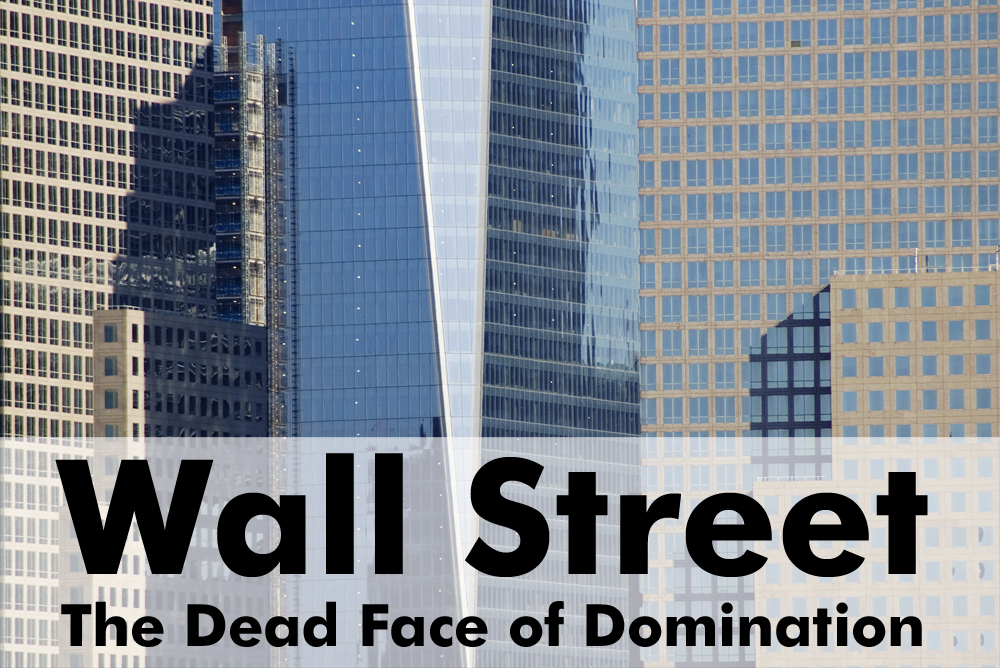
Dead Face of Domination

For an explanation with a positive, if silent, ending, see Wall Street: The Dead Face of Domination.

On why the protests won’t stop, see The Banker’s Don’t Get It.

Top 5 Reasons Why The Occupy Wall Street Protests Embody Values Of The Real Boston Tea Party | ThinkProgress

4 Oct

In recent years, the Boston Tea Party has been associated with a right-wing movement that supports policies favoring powerful corporations and the wealthy. … However, the Occupy Wall Street demonstrations picking up momentum across the country better embody the values of the original Boston Tea Party. …

1.) The Original Boston Tea Party Was A Civil Disobedience Action Against A Private Corporation. …

2.) The Original Boston Tea Party Feared That Corporate Greed Would Destroy America. …

3.) The Original Boston Tea Party Believed Government Necessary To Protect Against Corporate Excess. …

4.) The Original Boston Tea Party Was Sparked By A Corporate Tax Cut For A British Corporation. …

5.) The Original Boston Tea Party Wanted A Stronger Democracy. There is a common misconception that the Boston Tea Party was simply a revolt against taxation. The truth is much more nuanced, and there were many factors behind the opposition to the East India Company and the British government.

Top 5 Reasons Why The Occupy Wall Street Protests Embody Values Of The Real Boston Tea Party | ThinkProgress.

On Wall Street, a Protest Matures – NYTimes.com

4 Oct

ANDREW ROSS SORKIN, who gets phone calls from Wall Street CEOs went down to Zuccotti Park to check out the protest.

“Is this Occupy Wall Street thing a big deal?” the C.E.O. asked me. I didn’t have an answer. “We’re trying to figure out how much we should be worried about all of this,” he continued, clearly concerned. “Is this going to turn into a personal safety problem?”

A personal safety issue? No. But . . .

… the underlying message of Occupy Wall Street — which spread to Boston, Chicago and Los Angeles on Monday — is something the big banks and corporate America may finally have to grapple with before it actually does become dangerous.

What’s the message?

At times it can be hard to discern, but, at least to me, the message was clear: the demonstrators are seeking accountability for Wall Street and corporate America for the financial crisis and the growing economic inequality gap.

And that message is a warning shot about the kind of civil unrest that may emerge — as we’ve seen in some European countries — if our economy continues to struggle.

via On Wall Street, a Protest Matures – NYTimes.com.

“Occupy Wall Street,” today’s Whiskey Rebellion – The Labor Movement – Salon.com

3 Oct

Like it or not, though, it is Occupy Wall Street that has the most in common, ideologically, not with those Boston merchants and their supporters but with the less well-known, less comfortably acknowledged people who, throughout the founding period, cogently proposed and vigorously agitated for an entirely different approach to finance and monetary policy than that carried forward by the famous founders. Amid horrible depressions and foreclosure crises, from the 1750′s through the 1790′s, ordinary people closed debt courts, rescued debt prisoners, waylaid process servers, boycotted foreclosure actions, etc. (More on that here and here.) They were legally barred from voting and holding office, since they didn’t have enough property, so they used their power of intimidation to pressure their legislatures for debt relief and popular monetary policies. Their few leaders in legit politics included the visionary preacher Herman Husband, the weaver William Findley, and the farmer Robert Whitehill.

via “Occupy Wall Street,” today’s Whiskey Rebellion – The Labor Movement – Salon.com.