Archive | Seven Principles RSS feed for this section

Becoming Locavores, One Locally Grown Meal at a Time – Aliso Viejo, CA Patch

28 Feb

“Connections create resilience,” said Leeds, an Aliso Viejo resident. “We’re going to have to re-evaluate how we live our lives. When oil gets really expensive, food costs will rise. We are not sustainable at this point.”

In September 2011, Leeds started holding potlucks to raise awareness about “creating community through resilience.” With a steering committee of nine members, she introduced the Transition Movement to Aliso Viejo….

To help residents become locavores, people who eat food that is grown locally, members of Transition Aliso Viejo are helping each other install backyard gardens. Under the guidance of Karen Wilson, a master gardener with the Orange County Great Park in Irvine, a workgroup of 10 Transition members performs the labor for each garden.

Leeds admits that each homeowner can’t grow everything they need, so she is encouraging them to share or trade what they grow with their neighbors.

via Becoming Locavores, One Locally Grown Meal at a Time – Aliso Viejo, CA Patch.
Do Liberals Disdain the Disabled? – NYTimes.com

28 Feb

Another area with liberals  and conservatives can work together:

Care for people with disabilities has quietly been one of the few causes in this country on which social liberals and conservatives could put aside their differences to get important work done. I fear this may be changing, and at the precise moment when budget crises and the knife fight over health care reform place the future of key disability services into doubt. . . .

Liberals and conservatives deserve credit for working together to promote genuine progress in these areas. It isn’t easy, because we have genuine differences regarding the size and role of government, abortion, separation of church and state. But Mr. Santorum wants to exploit these differences. Mr. Santorum faces an uphill political climb. But whatever happens with his candidacy, he can still tear this particularly delicate piece of our social fabric before he’s through. We can’t let him do that.

via Do Liberals Disdain the Disabled? – NYTimes.com.

Bell Labs, Innovation for the Ages

26 Feb

Bell Labs, Innovation for the Ages

Jon Gertner has an interesting article in today’s New York Times about Bell Labs, the place that gave us the transistor and the Unix operating system, information theory and the background radiation of the universe, among many other ideas and devices. It was perhaps the greatest industrial lab America, or the world, has seen. Ever. So far.

in the search for innovative models to address seemingly intractable problems like climate change, we would do well to consider Bell Labs’ example — an effort that rivals the Apollo program and the Manhattan Project in size, scope and expense. Its mission, and its great triumph, was to connect all of us, and all of our new machines, together.

In his recent letter to potential shareholders of Facebook, Mark Zuckerberg noted that one of his firm’s mottoes was “move fast and break things.” Bell Labs’ might just as well have been “move deliberately and build things.”

Perhaps the ecology of innovation has changed so much in the last couple of decades that Zuckerberg’s philosophy is the right one. Perhaps not. So far Facebook is only one idea.

And again: Continue reading

Squatter’s Space in Berlin | Urbanscale

25 Feb

Some provocative paragraphs from the newsletter of a an urban design firm in NYC. The underlying theme is a call for a more flexible and resilient use of urban space.

A further instructive example, this one European, might be Kunsthaus Tacheles, the squatted former department store in the Mitte district of Berlin. Until its shuttering earlier this year, Tacheles supported the widest possible array of creative activity; unimpeded by any sort of regulation, the single structure functioned as a mothership for dozens of ad hoc artist’s studios, workshops, performance spaces, restaurants and bars.

Anyone who ever spent so much as an hour on the grounds of Tacheles will remember a few things about the place: its energy, of course. The way it encouraged (and rewarded) curiosity. The multiple modes in and through which you could engage it and the people who made it what it was. The point isn’t that every place can or should be reimagined as a graffiti-bedizened hive self-managed on anarchist lines — though a boy can wish — but that particularly intensive mixed use gives rise to a vivid and resonant micro-urbanity that has to be experienced to be understood.

via Week 39: On space as a service | Urbanscale.

Symposium on Graeber’s Debt

23 Feb

Symposium on Graeber’s Debt

As I’ve all ready noted, Crooked Timber is running a symposium on David Graeber’s Debt: The First 5000 Years. Contributions so far:

All are worth reading, as are many of the comments. I’ll end with the last paragraph from Bertram’s introduction:

Does Graeber find in utopian and democratic resistance to the Axial empires an historic precedent for the Occupy movement to emulate? Perhaps our best possibilities lie not in grand schemes of societal transformation but in developing the “baseline communism” and the democratic instincts that persist even in the heart of modern capitalism. The anarchist writer Colin Ward used a phrase from Ignazio Silone – “the seed beneath the snow” – to make a similar idea vivid. We cannot take the beast on in a direct assault, and nor should we, but we can work together to develop a more human society within the nooks and crannies of the commercial one.

Sounds a bit like a plug for the Transition Movement, which originated in England and has since spread around the world.

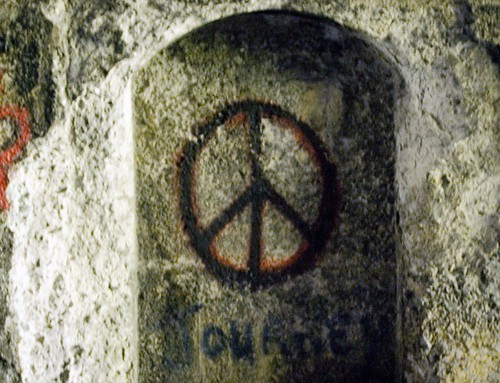
Peace Symbol: Nuclear Disarmament

21 Feb

one of them old time good ones

The peace symbol is one of the most widely known symbols in the world. It was created in 1958 by Gerald Holtom as a symbol for the Campaign for Nuclear Disarmament (CND). The symbol combines the semaphor (signal flag) symbols for “N” and “D” (nuclear disarmament). In the “N” the flags are held pointing diagonally toward the ground and, for the “D” one points up and one down, forming a vertical line.

The symbol was used in first anti-nuclear march in London (to Aldermaston, where nuclear weapons were manufactured) in 1958. One of Martin Luther King’s associates, Bayard Rustin, attended that march and brought the symbol back to the US. It was adopted by anti-war movement and has since become a universal symbol of peace.

Note that the symbol has not been copyrighted. The CND explains:

Although specifically designed for the anti-nuclear movement it has quite deliberately never been copyrighted. No one has to pay or to seek permission before they use it. A symbol of freedom, it is free for all. This of course sometimes leads to its use, or misuse, in circumstances that CND and the peace movement find distasteful. It is also often exploited for commercial, advertising or generally fashion purposes. We can’t stop this happening and have no intention of copyrighting it. All we can do is to ask commercial users if they would like to make a donation. Any money received is used for CND’s peace education and information work.

Occupy Wall Street and a New Politics for a Disorderly World | The Nation

10 Feb

An experience diplomat, who knows top-downism from the inside, says Occupy is the best thing going.

A new politics is needed, and in the early weeks of Occupy Wall Street, I saw signs of its emergence. Some would see the Occupy protests as yet more evidence of disorder, not its solution. But to my jaded eye, the beacons pointing to a better method were bright indeed. At the UN Security Council and other diplomatic forums, I had taken part in high-stakes negotiations on everything from Iraqi WMDs to Palestine to the future of the Balkans. But the experience of hundreds of people listening to the voice of one—anyone!—through the “people’s mic” moved me more than any of those worldly negotiations. This was a politics of the many, included at last, at least in the small square of Zuccotti Park, if not in our distant capitals. Here I saw true respect, not the pretend respect of diplomacy. Here I saw involving and passionate debate, not the childish antagonism of Internet debate or the partisan rancor of Washington. The crowd was gripped by an unfamiliar emotion, a shared sentiment that others were listening and that their decisions truly mattered.

This is the start of a new politics, but obviously mere meetings and protest marches are not enough. There is nothing certain about the future, save that it is our actions that will create it and that others are already exploiting our inaction. It is no longer sufficient to appeal to government to put things right; a corrupted system will not reform itself. We must create new systems, new modes of decision-making and interaction, and new forms of economic behavior to replace the old.

via Occupy Wall Street and a New Politics for a Disorderly World | The Nation.

10 States Given Waivers From No Child Left Behind Law – NYTimes.com

9 Feb

“After waiting far too long for Congress to reform No Child Left Behind, my administration is giving states the opportunity to set higher, more honest standards in exchange for more flexibility,” President Obama said in the statement. “Today, we’re giving 10 states the green light to continue making reforms that are best for them. Because if we’re serious about helping our children reach their potential, the best ideas aren’t going to come from Washington alone. Our job is to harness those ideas, and to hold states and schools accountable for making them work.”

via 10 States Given Waivers From No Child Left Behind Law – NYTimes.com.

8 Amazing Green Buildings That Break Even on Energy Consumption

8 Feb

A zero-energy building is one that produces as much energy as it consumes, making it a net-zero energy property and eliminating energy bills for its owners. Although zero-energy homes and buildings are quite rare today, increasing concerns about energy waste have set the stage for a growing market….

Zero-energy initiatives are so popular that even the U.S. Department of Defense (DoD) is getting in on the action, with plans to build its first renewable energy project, to be called Fort Irwin Solar. This should be the start to massive savings for the DoD, as it spends $4 billion per year on energy for its 300,000 buildings.

via 8 Amazing Green Buildings That Break Even on Energy Consumption.

Facebook Is Using You – NYTimes.com

5 Feb

In Europe, laws give people the right to know what data companies have about them, but that is not the case in the United States….

Ads that pop up on your screen might seem useful, or at worst, a nuisance. But they are much more than that. The bits and bytes about your life can easily be used against you. Whether you can obtain a job, credit or insurance can be based on your digital doppelgänger — and you may never know why you’ve been turned down.

Material mined online has been used against people battling for child custody or defending themselves in criminal cases. LexisNexis has a product called Accurint for Law Enforcement, which gives government agents information about what people do on social networks. The Internal Revenue Service searches Facebook and MySpace for evidence of tax evaders’ income and whereabouts, and United States Citizenship and Immigration Services has been known to scrutinize photos and posts to confirm family relationships or weed out sham marriages.

via Facebook Is Using You – NYTimes.com.