

Archive | Inner and Outer RSS feed for this section
Follow the Acorns: Totoro Isn't Gojira, can you find him in YOUR back yard?
16 MarAnyone familiar with Japanese popular culture knows that it is haunted by the atomic bombs of Hiroshima and Nagasaki. Ishiro Honda’s Gojira is one seminal example of that haunting. But those evil ghosts are by no means the only spirits animating the Japanese psyche and landscape. In this post I examine the life spirit Hayao Miyazaki has embodied in My Neighborhood Totoro, a story that is rich with a deep sense of locality, locality as humble as an acorn and as exhalted as a mighty camphor. Even as we meditate on Gojira as a cautionary tale about techno-hubris, let us also meditate on Totoro as an affirmation of life.

My Neighbor Totoro is set in rural Japan in the 1950s. The story centers on two young girls, Mei and Satsuki, and the Totoro. Along with their father, the girls have moved into a rural house that’s near the sanitarium where their mother is hospitalized. As the story opens the three of them are in a small moving truck traveling the final distance to their new home. They arrive, stop the truck, and start moving in.
As you know, the story is set in rural Japan in the 1950s. The story centers on two young girls, Mei and Satsuki, and the Totoro. Along with their father, the girls have moved into a rural house that’s near the sanitarium where their mother is hospitalized. As the story opens the three of them are in a small moving truck traveling the final distance to their new home. They arrive, stop the truck, and start moving in.
About six minutes in – the film is roughly 86 minutes long – Satsuki and Mei notices a huge tree towering over the forest. Their father tells them it’s a camphor tree (that’s it, at the head of the post). We’ll see this tree again; it’s a major motif in the film.
About a minute later – 6:41 – Satsuki notices an acorn on the floor in a room. And another. For the next minute or so she and Mei will chase down acorns. Father suggests they’re evidence of squirrels . . . or rats.
The girls begin to investigate the rear of the house and, upon entering, detect soot sprites, which will have their attention for the next eight minutes or so, to about 16 minutes in. Soot sprites are small fuzzy balls of soot with eyes. There are lots of them, and they seem to have something to do with the acorns. The girls report back to their father, who has been joined by Granny, the old woman who’s been taking are of the house. She’s the one who identifies the little creatures as, yes, soot sprites, and tells the family a bit about them.
We now know that there’s a bit of fantasy in this world, and its visible to children, but not adults – that’s what Granny said.
At this point we’re roughly a fifth of the way through a film named after Totoro and we haven’t seen one, nor even a hint of one. That won’t happen until roughly 29 minutes in, a bit over a third of the way through the film. But I’m getting ahead of the action.
They finish out that first day doing this and that and end up taking a bath, all three of them together – this is, after all, Japan. They laugh vigorously to drive the spirits from the house – and the last of the soot sprites scurry away. The next day they travel to the sanitarium to visit their mother (and the father his wife). On the third day, Satsuki prepares box lunches for the three of them. She heads off to school, father goes into the study, and Mei sets out to play.
By this time we’ve forgotten about the acorns and the soot sprites.
At about 28 minutes in Mei spots an old bucket with its bottom rusted out. She picks it up, looks through the hole, and what does she see? An acorn, that’s what:

One acorn leads to another and before you know she’s got a pocket full. Then she spots a pair of ears sticking up from the grass:

Perhaps they’re rabbit ears. But no, when she sees the whole creature, it’s not a rabbit, it’s not even fully solid. It’s translucent. It can’t be a “real” creature:

Gojira 1954: No More Nukes
14 MarHere’s blast from the past, a review of Gojira, which I published in The Valve three years ago. Since this film is about nuclear anxiety it is highly relevant to the current emergency in Japan. I would also add that the Japanese original is superior to the film that appeared in America as Godzilla and scared the stuffing out of me when I was a kid. The Japanese original is richer and has a sense of grave ritual that is missing from the American hatchet job.
It came out less than 10 years after the end of WWII and about a century after Commodore Perry goaded the Japanese into investigating Western ways and refitting them into Japanese ways. Gojira has two interlinked storylines: the story about the monster from the sea and a story about love vs. arranged marriage, which grapples with tradition vs. change. The second one was dropped from the American re-edit. In this essay I suggest — but no more than that, suggest — that the two storylines are, deep down, but one storyline.
A review of Gojira, Ishiro Honda, dir. Toho Co, Ltd. 1954; reissued by Classic Media 2006.
On March 1, 1954, the United States detonated Castle Bravo at Bikini Atoll in the South Pacific. Castle Bravo was a hydrogen bomb with a yield of 15 megatons, roughly two or three times what had been expected. It was the largest radiological accident ever caused by the land of the free and the home of the brave and poisoned the crew of a Japanese tuna boat, the Daigo Fukuryu Maru (Lucky Dragon No. 5), with one crew member eventually dying of leukemia. This led to a tuna scare in Japan and a petition drive to ban the bomb.
Tomoyuki Tanaka was one of many Japanese who followed the story closely. He worked as a producer for Toho Company, Ltd., one of Japan’s major film studios. When a deal fell through and created a hole in the studio’s release schedule, Tanaka decided to fill it with a new kind of film, a sci-fi horror story filmed in noir style and featuring a prehistoric beast awakened by an atomic explosion. The beast was named Gojira and the film was released in Japan on November 3, 1954.
If you look closely, you’ll see a reference to Lucky Dragon No. 5 early in Gojira. The movie opens on a freighter at sea off Odo Island, the Eiko-Maru. It’s evening and some of the sailors are gathered together while one of them plays the guitar and another the harmonica. There’s a sudden bright light and a loud noise. The sailors rush to the side of the ship to see what’s happened:

Notice the number on the life preserver, “No. 5.” The freighter sinks and all hands are lost.
Thus begins Gojira. It builds slowly. Another ship is lost, meetings are held, decisions made, and eventually a scientific team is sent Odo Island to investigate. The team is headed by Dr. Kyouhei Yamane, a noted paleontologist, who is accompanied by his daughter Emiko and Hideto Ogata, who works for the steamship company that’s lost two boats. At long last, 21 minutes into a 98 minute film, we catch our first glimpse of Gojira:

Gojira’s footprints are saturated with Strontium 90, as is the Island’s well water, evidence that Gojira as been tainted by radiation from some otherwise unidentified nuclear test. Beyond that, we know and learn little about why Gojira’s on the rampage. It’s simply an ugly fact, the monster’s been awakened and is heading toward Tokyo, what do we do?
Sustaining a Life in the Desert
10 MarThe New York Times just ran a story about John Wells, who lives off the grid on 60 acres of West Texas desert. He calls his place the “Southwest Texas Alternative Energy And Sustainable Living Field Laboratory.” As Wells hit middle age got tired of a city-based life style and mounting debt. His father died and Wells began to rethink his life. As he says at his website:
Several years ago I began experimenting with alternative energy. I feel that the technology today has advanced enough and the costs have dropped to the point where just about anyone can make the move to off the grid living. This just happened to coincide with discovering accounts of pioneer life of some of my relatives from over 100 years ago. Their lives were difficult back then, but I sensed a feeling of great joy and accomplishment in overcoming hardship – where hard work payed off and living life was a fulfilling experience. I began to envision my life as a pioneer in the 21st century, and have chosen to follow that path.
In taking inventory of my life to this point in time, I believe that over the years I have picked up just the right skills and mentality to live my dream of how I would do it if I had it to do all over again. I suddenly found myself at the perfect point in my lifetime to go for that dream.
And so he sold his house for $600K, paid off his debts, and moved from upstate New York to Texas. He lives on rainwater, solar power, composts his wastes, and is grows vegetables. He’s got a blog going back to 2008, and a bunch of photos at his Flickr site.
Wells, of course, is in a long tradition of go it aloners. One suspects he’d be doing this regardless of the society-wide need for Transition. And that’s the point, our society needs to make such a radical decision. We don’t all have to make the decision together, but by ones and twos and tens and more, we’ve got to start moving and start changing our communities.
Love the one you're with
21 Feb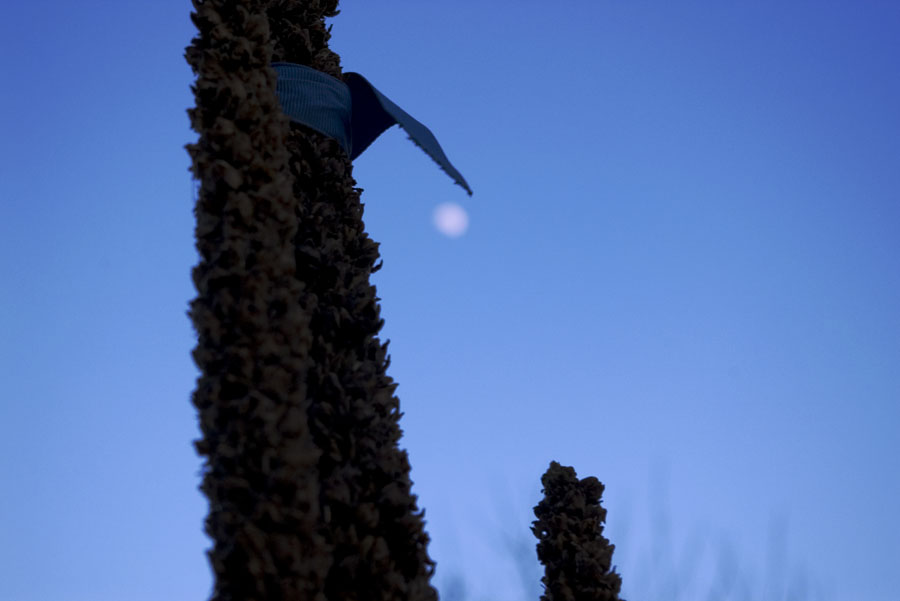
Weeds too are precious in the Great Transition. Especially when they frame Mother Moon.
Revolution, New Style, aka Transition
12 FebDumbeks along the Mississippi
The people of Egypt are writing a new chapter in the book of revolution. The story is by no means complete. We have no way of knowing how deep the changes will go. Mubarak has stepped down. But just what it means that the “higher council of the armed forces will lead the nation,” as Mubarak’s hand-picked VP has said, we don’t know. Nor, I suspect, does that higher council, or the protesters.
What does that mean for US here in the USA? Yes, it means the Middle East and Northern Africa are in transition and we’ve got to change our foreign policy. But that’s not what I’m talking about. What I’m talking about is here, on the ground, in the USofA. What do we do about OUR government?
No, we’ve not been living under a state of emergency for three decades. And, yes, we do have democratic elections, local, state, and federal. But one can’t help but believe that the fix is in. Writing in The New York Times (of all places), Bob Herbert observes:
While millions of ordinary Americans are struggling with unemployment and declining standards of living, the levers of real power have been all but completely commandeered by the financial and corporate elite. It doesn’t really matter what ordinary people want. The wealthy call the tune, and the politicians dance.
We are being ruled by a class of people that is out of touch with life on the ground, and that has enough money that they need no longer walk the same soil with the rest of us. They look like us, talk like us, and walk like us. But more and more, they are less and less like us. They are becoming aliens. Our alien overlords.
How do we get out from under them? We don’t want violence, we don’t want bloodshed. But we want to turn the country around and march to the future, not admire our accomplishments in the mirror of the past. Those accomplishments were built on abundant resources and those resources are becoming scarce. Even as the oil runs out, the peoples of Asia, Africa, and South America are calling for their just share of the world’s resources. The world is changing and the Democrats and the Republicans in the USofA don’t know it. They’re doing their damnedest to keep the old machines running.
What happens when those machines run out of oil?
We can’t wait for them to wake. What can we do now to reclaim our lives and our future? And how to we regain control of our political system? The Egyptians have made their move in a political system that has far less room for movement than our system has. Let’s not let our relative freedom trick us into believing we can rest secure in business as usual. To quote Bob Herbert again, “the Egyptians want to establish a viable democracy, and that’s a long, hard road. Americans are in the mind-bogglingly self-destructive process of letting a real democracy slip away.”
The Egyptians have begun the arduous, but fulfilling task of rebuilding their society from the ground up. Let’s take their new beginning as a call for us to emulate them and do the same in our world.

 Truth and Traditions