Archive | Biodiversity RSS feed for this section

Big Food Must Go: Why We Need to Radically Change the Way We Eat | Labor | AlterNet

3 Mar

“Occupying the food system” has emerged as a rallying cry as activists and movements across the country, from Willie Nelson to more than 60 Occupy groups are turning up the heat on “big food” in nationwide actions today. Across the US, online and offline, thousands will be protesting icons of corporate control over food such as Monsanto and Cargill, and literally occupying vacant lots and tilling long-ignored soils in a mass-scale rejuvenation of community-led food production. (Find out more about the day of action here.)

“We want to ignite a robust conversation about corporate control of our food supply,” says Laurel Sutherlin, communications manager for Rainforest Action Network, a lead organizer in this growing coalition of food system occupiers. “Occupy has opened a national dialogue about inequality and the dangers of surrendering our basic life-support systems over to corporate control.”

via Big Food Must Go: Why We Need to Radically Change the Way We Eat | Labor | AlterNet.

The Limits to Growth

28 Feb

Dermit O’Conner, in association with the Post Carbon Institute, has made this cartoon illustrating the problems that are now piling up all around us: There’s No Tomorrow:

Well, there IS a tomorrow, but we’re going to have to change a few things to get there, hence Truth and Traditions. The cartoon was hatched by folks a Hubbert’s Arms, a discussion space for people transitioning to a post-carbon world.

Here’s the script for the film, along with references and links to further information.

Beyond .350: Measuring New Thresholds of Global Collapse | Environment | AlterNet

23 Feb

But in today’s issue of the journal Nature, Rockstrom and 27 of his fellow environmental scientists argue that we have to conceive of many tipping points at once. They propose that humans must keep the planet in what they call a “safe operating space,” inside of which we can thrive. If we push past the boundaries of that space — by wiping out biodiversity, for example, or diverting too much of the world’s freshwater — we risk catastrophe.

Unfortunately, the authors of the Nature paper maintain, we’ve already started pushing out beyond these boundaries without knowing where they actually are. “We’re sitting on top of a mesa right now, and we’re driving around, but we don’t have our lights on and we don’t even have a map,” says Jonathan Foley, a co-author of the new study and the director of the University of Minnesota’s Institute on the Environment. “That’s a dangerous way to move around.”

via Beyond .350: Measuring New Thresholds of Global Collapse | Environment | AlterNet.

New Life, From an Arctic Flower That Died 32,000 Years Ago – NYTimes.com

20 Feb

Living plants have been generated from the fruit of a little arctic flower, the narrow-leafed campion, that died 32,000 years ago, a team of Russian scientists reports. The fruit was stored by an arctic ground squirrel in its burrow on the tundra of northeastern Siberia and lay permanently frozen until excavated by scientists a few years ago.

This would be the oldest plant by far that has ever been grown from ancient tissue.

via New Life, From an Arctic Flower That Died 32,000 Years Ago – NYTimes.com.

Have Bees Become Canaries In the Coal Mine? Why Massive Bee Dieoffs May Be a Warning About Our Own Health | | AlterNet

17 Feb

A few years ago bees starting dieing in large numbers, large enough that there are serious doubts about agriculture, as many food plants (and others) are pollinated by bees. We don’t know what’s going on, but we keep messing with the environment anyway.

Hackenberg isn’t doing as poorly as he was several years ago, but he attributes that to feeding the bees protein and supplements like brewers yeast and eggs and “kicking them in the pants with all kinds of nutrition because what they are gathering out there in nature is not what it’s supposed to be.” Hackenberg says, “We — America or the world — has messed up the bees’ diet. Not only the bees’ diet but everyone else’s diet. We just don’t have the nutrition that’s out there in the food and bees are telling us this because what they are bringing home — they can’t make it anymore. We’re supplementing them… and the bees are eating it… But go back 10-15 years ago, we didn’t need this stuff.”

A key question is whether the problem is simply a laundry list of unrelated factors (i.e. pesticides, disease, parasites, etc.) or whether those factors interact synergistically to kill bees.

Are we as vulnerable as our bees?

Beekeepers see their bees as the canaries in the coal mine. All living beings are exposed to the cocktail of pesticides and other chemicals in our midst, each in sub-lethal doses but all mixing together and interacting in our bodies. Many Americans, like bees used to pollinate monocultures, do not eat very healthy or nutritious diets, and our stressful and sedentary lifestyles put us at even more risk of succumbing to illness. Are the bees giving us a message we should be heeding?

via Have Bees Become Canaries In the Coal Mine? Why Massive Bee Dieoffs May Be a Warning About Our Own Health | | AlterNet.

Biologists: Lone Gray Wolf Crosses Into California – From the Wires – Salon.com

30 Dec

SAN FRANCISCO (AP) — A lone gray wolf has wandered across the Oregon border into California in what wildlife officials hailed Thursday as the historic return of a species not seen in the state in more than 80 years. …

The last confirmed wild gray wolf in California was killed in 1924 by a trapper protecting livestock. Conflict between wolves and ranchers across the West remains a key point of tension as reintroduction efforts in recent decades have led to the species’ spread.

via Biologists: Lone Gray Wolf Crosses Into California – From the Wires – Salon.com.

With Deaths of Forests, a Loss of Crucial Climate Protectors – NYTimes.com

2 Oct

Forests are dying all over the world in one way or another. The effects could be disastrous.

Scientists say the future habitability of the Earth might well depend on the answer. For, while a majority of the world’s people now live in cities, they depend more than ever on forests, in a way that few of them understand.

Scientists have figured out — with the precise numbers deduced only recently — that forests have been absorbing more than a quarter of the carbon dioxide that people are putting into the air by burning fossil fuels and other activities. It is an amount so large that trees are effectively absorbing the emissions from all the world’s cars and trucks.

Without that disposal service, the level of carbon dioxide in the atmosphere would be rising faster. The gas traps heat from the sun, and human emissions are causing the planet to warm.

via With Deaths of Forests, a Loss of Crucial Climate Protectors – NYTimes.com.

This seagull opposes nuclear energy

11 Sep

IMGP3156rd

Tired of Trashy Politics?

31 Aug

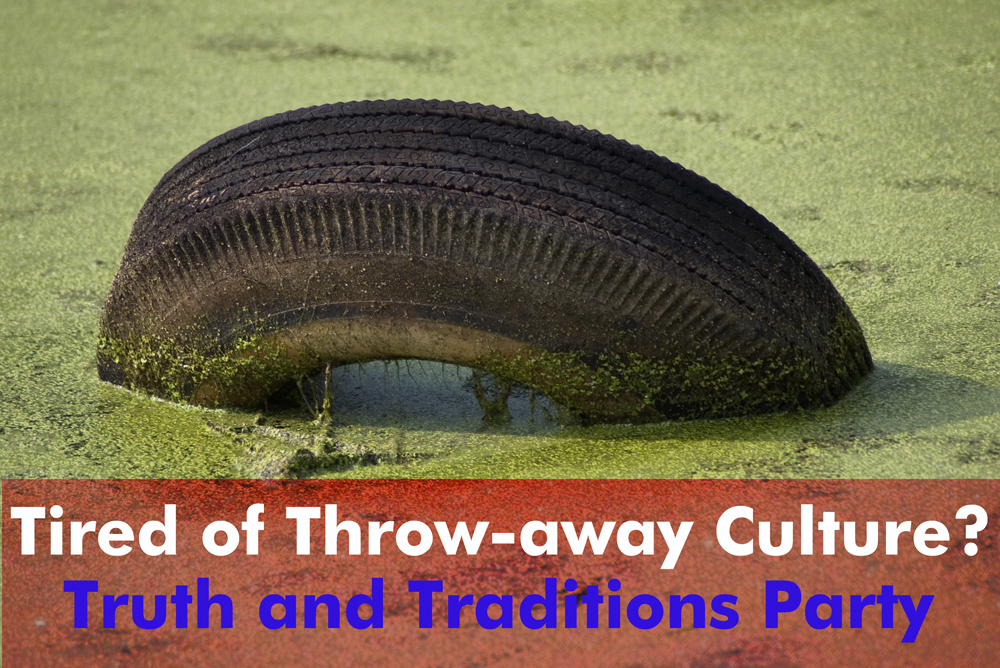
tired of throwaway culture?

New York Denies Indian Point Plant a Water Permit – NYTimes.com

31 Aug

The battle is joined. It’s New York State vs. the Federal Government.

… the strongly worded letter from the Department of Environmental Conservation, issued late Friday, said flatly that Indian Point’s cooling systems, even if modified in a less expensive way proposed by Entergy, “do not and will not comply” with New York’s water quality standards.

It said the power plant’s water-intake system kills nearly a billion aquatic organisms a year, including the shortnose sturgeon, an endangered species. The letter also said that radioactive material had polluted the Hudson after leaking into the groundwater.

via New York Denies Indian Point Plant a Water Permit – NYTimes.com.